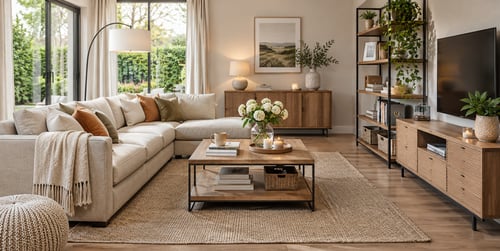
When a whole living room is waiting to be furnished, which piece should you buy first? The sofa sets the scale, and the coffee table, TV stand and storage are then chosen to suit both the sofa and the measurements of the room. Start from the other end and you are guessing at proportions you cannot see yet. Here is how to choose furniture for a living room in that order, starting with a tape measure and finishing with the details that tie the room together!
Living room buying checklist:
- Measure first - the walls, plus every doorway, hallway and staircase on the delivery route
- Sofa size - width for the wall, seat depth and height for the people using it
- Coffee table - close to the sofa seat in height, in a shape that is easy to walk around
- TV stand - wider than the TV base and rated for its weight
- Sets or mixing - a shared finish or material makes separate pieces look related
How to choose living room furniture: key factors before you shop
A tape measure and a floor plan come before any shortlist. Note the length of each wall and the position of radiators, windows and doors, then measure the delivery route too, because a sofa that fits the room can still get stuck in a narrow hallway or on a staircase. Decide now whether the room has to sleep the odd guest, since the choice between sofas and sofa beds changes how much floor the piece needs once it is open.
The way the room is used decides which pieces earn their place. A household that watches films every evening needs comfortable seats and a clear view of the screen, while a room kept for reading and visitors calls for more surfaces and good lamps. For a room with several jobs, list the three or four things that happen there most often and give each planned piece a role from that list.
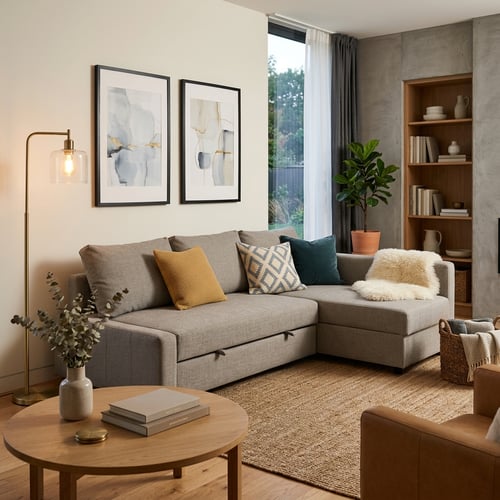
Finishes need a plan as well, because separate purchases look related when wood tones and colours repeat. Start with the largest wooden surface, which is often a TV stand or a sideboard, and match the smaller pieces to it. White living room furniture keeps big items looking lighter in a small room. Black living room furniture gives a strong outline, so it tends to look best on one or two pieces, with lighter finishes around them.
How to pick a sofa: size, shape, fabric and comfort
The right sofa fits the wall it stands against and the people who use it every day. The order is simple: settle the size first, let the room decide the shape, and choose the fabric last.
Sofa size: width, seat depth and seat height
Width comes from the wall and from the walkway around the sofa, so measure both and leave room to walk past its arms. Seat depth decides how you sit: shallower seats keep your back upright for conversation, while deeper ones suit lounging. Seat height matters most for anyone who finds standing up hard, as a low seat makes getting up more effort. Compare the figures with a sofa you already find comfortable before ordering.
Sofa shape: straight or corner
A straight two- or three-seater suits a single long wall, while a corner sofa fills two walls and gives more seats without a second sofa. Our corner sofas at Dako include models with a universal orientation, which means the corner section can be set up on either side. The LYNDA, for example, is 206 cm wide with a seat depth of 49 cm and a seat height of 43 cm - figures worth comparing with your wall and your current sofa.
Sofa fabric and comfort
Upholstery has to cope with the household, so think about who uses the sofa before you look at colours.
Match the fabric to daily life:
- Pets - tightly woven fabrics snag less on claws than loose, textured weaves
- Children - darker or patterned covers hide marks between cleans
- Sunny rooms - strong light fades many fabrics, so colour and position both matter
- Cleaning - the care instructions tell you how a spill can be treated
Comfort is personal, and the surest test is to sit on a sofa with similar measurements the way you do at home, leaning on an arm or with your legs up, for several minutes.
How to choose a coffee table: shape, height and material
A coffee table works best at roughly the height of the sofa seat, in a shape that leaves a clear path around it and a top that suits what lands on it every day. Keep it close enough to reach a cup without stretching and far enough away to walk past without turning sideways.
Coffee table shape and size
In a small room, a round or oval top is easier to walk around and has no corners to catch knees on. Rectangular tables suit long sofas and corner sofas, where several people need to reach the surface, and a table clearly shorter than the sofa keeps the arrangement balanced.

Coffee table material
Glass looks lighter and keeps a small room feeling open, while wood adds warmth and hides small marks better. Repeating the wood or metal of the sofa legs, or the finish of nearby storage, keeps the table looking part of the plan. In a home with small children, rounded edges are kinder than sharp corners.
TV stands: how to choose the right size, height and style
A TV stand should be wider than the base of the TV, rated for its weight and low enough that the middle of the screen sits close to eye level when you are seated. Measure the TV across its feet or stand plate, which is often narrower than the screen, and allow extra width if a soundbar will sit in front.
Check these details in the specification:
- Load capacity - the maximum weight the top can carry, compared with your TV
- Depth - enough for the TV feet to stand fully on the top
- Height - low enough for comfortable viewing from your usual seat
- Cable access - holes or an open back so leads reach the socket
- Closed storage - drawers or doors for remotes, consoles and chargers
A quick tip before you order: if a bigger TV is likely in the next few years, choose a stand that will suit that set rather than the one you own now. Secure tall or narrow units to the wall with anti-tip straps, especially in a home with young children.
Side tables and console tables: where they work and how to choose them
Both are small tables with different jobs: one holds things within reach of a seat, the other gives a slim surface where there is little floor to spare.
Where side tables work best
Side tables belong next to a sofa arm or an armchair, anywhere a cup, a book or a lamp needs a place. A top roughly level with the arm is easy to reach without leaning, and it should be wide enough for a lamp base with room left for a mug. In a busy room, a table with a lower shelf keeps magazines and remotes off the floor.
Where console tables work best
Console tables are long and shallow, so they fit behind a sofa that stands away from the wall, along a hallway or under a mirror. Their slim depth suits lamps, keys and display pieces, and a model with a drawer or lower shelf adds a little storage. Behind a sofa, a console at about the height of the sofa back makes a natural ledge for a lamp.

Living room storage solutions: furniture that hides the clutter
Good storage solutions start with a list of what needs a home, such as remotes, chargers, games, books, paperwork and spare blankets. Closed storage with doors and drawers hides everyday clutter, while open shelves suit the things you want on show.
Choose the type by what you keep:
- Sideboards - drawers for small items and cupboards for larger ones behind closed fronts
- Open shelving - books, plants and display pieces you want to see
- Storage ottomans - blankets and cushions, with a seat or footrest on top
Large storage pieces take up a lot of floor and need space in front of them, so measure their depth and check that doors and drawers can open fully without hitting the sofa or a radiator. With oak living room furniture, read the material line of the specification as well: a name with oak in it can describe the colour of the finish, and the material line shows whether the piece is solid timber or laminated board.
Living room furniture sets vs. mixing individual pieces
A matching set gives you several pieces in one finish from a single order, while mixing individual pieces lets you choose each item for its size and fit. Living room furniture sets take the guesswork out of coordination, and separate pieces give more control in rooms with alcoves or awkward walls.
Sets and mixed pieces compared:
What to compare | Furniture set | Individual pieces |
Coordination | One finish and style across the set | Built by repeating a finish, material or shape |
Fit to your room | Sizes fixed by the set | Each piece chosen for its own wall or gap |
Furniture you own | May look out of step with the set | Can stay and set the direction |
Changing later | Replacing one piece can break the match | Pieces can be swapped one at a time |
A mixed room still needs something that ties it together. Besides a shared wood tone, the metal of the table legs or a shape repeated across several pieces can do that job. Modern living room furniture helps here, as plain fronts and slim legs sit easily next to each other.
Building around what you keep, or starting with a new sofa
If some furniture is staying, the choice between a set and separate pieces is already half made. A sofa you like or a storage piece in good condition is a ready starting point, so build around it and repeat its finish. An empty room, or a sofa due for replacement, points the other way: buy the sofa first, then add a group of pieces in one finish. Our sideboards come in finishes including Oak Sonoma, Oak Canyon and Oak Sterling, so pick the one closest to the wood tone you are building around!
Author: Dako Furniture Team